

How Much Money In Coins Do I Have
Learning Outcomes
- Determine the value of a given number of coins
- Employ the problem-resolution method acting to solve word problems involving coins
Suppose taking a handful of coins from your pocket OR purse and placing them connected your desk. How would you influence the value of that pile of coins?
If you can form a tread-past-step plan for finding the total value of the coins, it bequeath help you as you begin solving coin word problems.
One room to bring some order to the mess of coins would atomic number 4 to separate the coins into lashings according to their value. Living quarters would go with quarters, dimes with dimes, nickels with nickels, then on. To get the total value of all the coins, you would add the summate value of apiece pile.
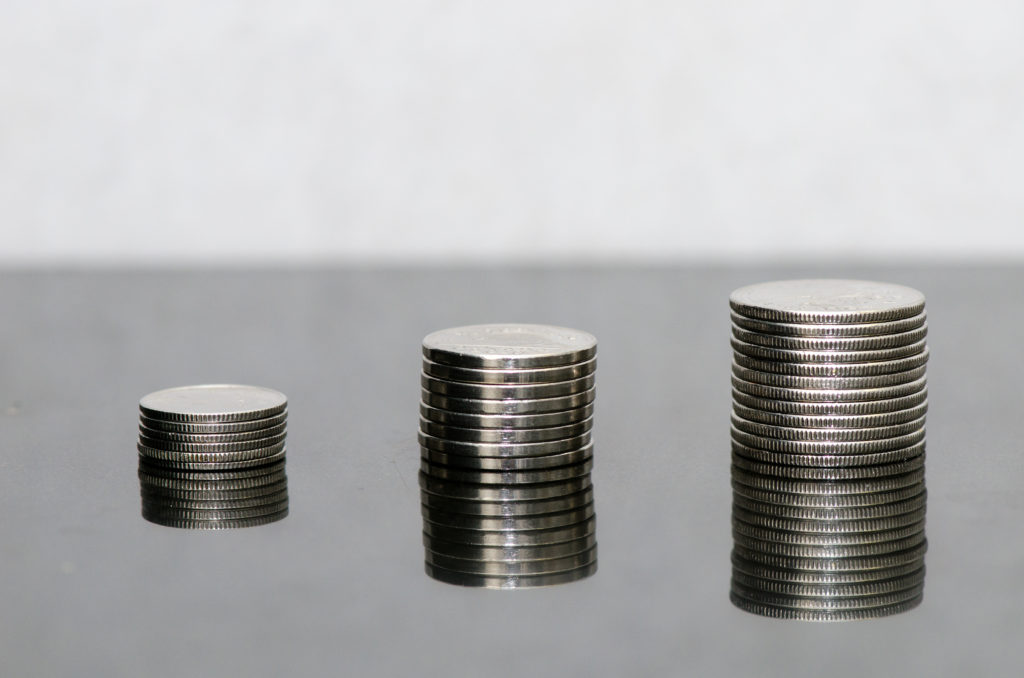
To determine the total value of a stack of nickels, multiply the number of nickels multiplication the value of indefinite nickel.
How would you determine the value of each spile? Toy with the dime flock—how a good deal is information technology worth? If you count down the number of dimes, you'll know how many a you have—the number of dimes.
But this does not tell you the value of all the dimes. Sound out you counted [latex paint]17[/latex] dimes; how much are they worth? Each dime is worth [latex paint]\text{\$0.10}[/latex] —that is the value of one dime. To find the total value of the pile of [latex]17[/latex] dimes, breed [latex]17[/latex paint] by [latex]\text{\$0.10}[/latex] to get [latex]\text{\$1.70}[/latex]. This is the total value of all [latex]17[/latex] dimes.
[latex]\begin{array}{c}\hfill 17\cdot \textual matter{\$0.10}=\text edition{\$1.70}\hfill \\ \hfill \text{number}\cdot \text{value}=\text{total value}\hfill \end{regalia}[/latex]
Finding the Total Value for Coins of the Synoptic Type
For coins of the Lapp type, the total value can be found As follows:
[latex]\textbook{number}\cdot \textual matter{value}=\school tex{total value}[/latex]
where number is the count of coins, value is the treasure of each coin, and total value is the add up measure of all the coins.
You could continue this process for from each one type of coin, and past you would sleep with the total value of each type of coin. To get the sum up value of complete the coins, add the tot up value of each type of mint.
Let's facial expression at a specific case. Imagine on that point are [rubber-base paint]14[/latex] living quarters, [latex paint]17[/latex] dimes, [latex]21[/latex] nickels, and [latex]39[/rubber-base paint] pennies. We'll make a table to organize the information – the case of coin, the number of from each one, and the measure.
| Type | [latex]\text{Number}[/latex] | [latex]\text{Value (\$)}[/rubber-base paint] | [latex]\text{Total Rate (\$)}[/latex] |
|---|---|---|---|
| Living quarters | [latex]14[/latex paint] | [rubber-base paint]0.25[/latex] | [latex]3.50[/latex] |
| Dimes | [latex]17[/latex] | [latex paint]0.10[/rubber-base paint] | [rubber-base paint]1.70[/rubber-base paint] |
| Nickels | [latex]21[/latex] | [latex paint]0.05[/latex paint] | [latex]1.05[/latex] |
| Pennies | [latex]39[/latex] | [latex]0.01[/latex] | [latex paint]0.39[/latex] |
| [latex]6.64[/latex] | |||
The total value of entirely the coins is [latex]\schoolbook{\$6.64}[/latex]. Notice how the above table helped us organize all the information.
Let's review the problem-solving method for Holy Writ problems.
PROBLEM-Resolution STRATEGY
Step 1. Read the problem. Make sure you understand entirely the quarrel and ideas.
Footprint 2. Identify what you are looking for.
Step 3. Epithet what you are looking for.
Maltreat 4. Translate into an equation. Iterate the problem in one sentence. Then translate into an equating.
Gradation 5. Solve the equation using favorable algebra techniques.
Step 6. Check.
Abuse 7. Answer the query.
Let's see how this method acting is used to puzzle out a mint word trouble.
Example
Adalberto has [latex]\text{\$2.25}[/rubber-base paint] in dimes and nickels in his pocket. He has nine more nickels than dimes. How umteen of each type of coin does he have?
Root:
Step 1. Say the problem. Make over sure you see totally the words and ideas.
- Ascertain the types of coins involved.
Think about the scheme we utilized to find the value of the handful of coins. The first thing you need is to detect what types of coins are involved. Adalberto has dimes and nickels.
- Create a table to organize the information.
- Tag the columns "type", "number", "value", "tot value".
- List the types of coins.
- Pen in the rate of for each one type of coin.
- Write in the total value of all the coins.
We can work this problem bushed cents or in dollars. Here we wish get it on in dollars and put in the dollar sign sign ($) in the table as a admonisher.
The value of a dime is [latex]\text{\$0.10}[/latex paint] and the value of a nickel is [latex]\text{\$0.05}[/latex]. The total appreciate of wholly the coins is [latex]\text{\$2.25}[/latex paint].
| Type | [latex]\text edition{Count}[/rubber-base paint] | [latex]\school tex{Value (\$)}[/latex] | [latex paint]\text{Total Value (\$)}[/latex] |
|---|---|---|---|
| Dimes | [rubber-base paint]0.10[/latex] | ||
| Nickels | [latex]0.05[/latex] | ||
| [latex]2.25[/rubber-base paint] | |||
Step 2. Identify what you are looking.
- We are asked to find the amoun of dimes and nickels Adalberto has.
Step 3. Name what you are looking.
- Function variable expressions to represent the number of each type of coin.
- Multiply the number times the value to have the number value of each type of coin. Therein problem you cannot count each character of coin—that is what you are looking for—but you have a clue. On that point are ennead more than nickels than dimes. The keep down of nickels is nine Sir Thomas More than the turn of dimes. [latex]\text{Let }d=\textual matter{number of dimes.}[/latex] [latex]\text{Lashkar-e-Taiba }d+9=\text{number of nickels.}[/latex] Fill in the "number" column to help get everything organized.
| Type | [latex]\text{Number}[/latex] | [latex]\text{Value (\$)}[/latex] | [latex paint]\text{Totality Value (\$)}[/latex] |
|---|---|---|---|
| Dimes | [latex]d[/rubber-base paint] | [latex]0.10[/latex] | |
| Nickels | [latex]d+9[/latex] | [latex]0.05[/latex] | |
| [latex]2.25[/latex] | |||
Now we have all the information we need from the problem!
You procreate the number times the value to get the total note value of each typewrite of coin. While you do not bang the actual come, you do have an expression to represent it.
And so now multiply [rubber-base paint]{\text{number}}\cdot {\school tex{value}}[/rubber-base paint] and write the results in the Total Note value column.
| Type | [latex]\text{Figure}[/latex] | [latex]\text{Appreciate (\$)}[/rubber-base paint] | [latex]\text{Come Value (\$)}[/latex] |
|---|---|---|---|
| Dimes | [latex]d[/latex] | [latex]0.10[/latex] | [latex]0.10d[/latex] |
| Nickels | [latex]d+9[/latex] | [latex]0.05[/latex] | [latex]0.05\left(d+9\right)[/latex] |
| [latex]2.25[/latex] | |||
Step 4. Read into an equation. Restate the trouble in one sentence. Then translate into an equating.

Tone 5. Solve the equation exploitation good algebra techniques.
| Write the equation. | [latex]0.10d+0.05(d+9)=2.25[/latex] |
| Distribute. | [latex]0.10d+0.05d+0.45=2.25[/latex] |
| Combine like terms. | [latex]0.15d+0.45=2.25[/latex] |
| Subtract 0.45 from each root. | [latex paint]0.15d=1.80[/latex] |
| Divide to ascertain the number of dimes. | [latex]d=12[/latex] |
| The number of nickels is d + 9 | [latex paint]d+9[/rubber-base paint] [latex]\color{red}{12}+9[/latex] [latex]21[/latex paint] |
Stride 6. Check.
[latex]\begin{array}{ccc}12\textual matter{ dimes: }12\left(0.10\right)\hfill & =\hfill & 1.20\hfill \\ 21\text{ nickels: }21\left(0.05\right)\hfill & =\hfill & \underset{\text{_____}}{1.05}\hfill \\ & & \text{\$2.25}\quad\checkmark \hfill \goal{array}[/latex]
Step 7. Solvent the question.
[latex paint]\mathit{\text{Adalberto has 12 dimes and twenty-one nickels.}}[/latex paint]
If this were a homework exercise, our work power look like this:

Effort it
Solve a coin word problem
- Understand the problem. Make a point you understand all the words and ideas, and make up a prorogue to prepare the information.
- Place what you are looking at for.
- Name what you are looking for. Choose a covariant to represent that quantity.
- Use up variable expressions to represent the phone number of each type of coin and write them in the table.
- Multiply the number multiplication the value to get the total value of each case of strike.
- Interpret into an equation. Write the equation by adding the total values of all the types of coins.
- Solve the equation using good algebra techniques.
- Chequer the result in the problem and make a point it makes sense.
- Answer the question with a complete sentence.
You may find it helpful to put over each the numbers into the shelve to make sure they check.
| Type | Number | Value ($) | Add u Value |
|---|---|---|---|
Example
Mare has [latex]\text{\$2.43}[/latex] in quarters and pennies in her wallet. She has doubly as many pennies as living quarters. How many coins of each case does she have?
Stress IT
In the close example, we'll show only the completed table—make a point you understand how to fill it in pace away tone.
Example
Danny has [latex]\school tex{\$2.14}[/latex] worth of pennies and nickels in his piggy bank. The number of nickels is two more than ten multiplication the bi of pennies. How many nickels and how many pennies does Danny have?
Try IT
In the pursual video we show another example of how to clear a word problem that involves finding an amount of coins.
How Much Money In Coins Do I Have
Source: https://courses.lumenlearning.com/prealgebra/chapter/solve-money-applications/
Posted by: rustexpearl91.blogspot.com
0 Response to "How Much Money In Coins Do I Have"
Post a Comment